
Cerebral palsy singles · Verified profiles

Dating With Cerebral Palsy

Dating With Cerebral Palsy and Building Real Cerebral Palsy Love

Meet people who already know that "How fast do you talk?" and "How do you get around?" are practical questions, not deal-breakers. Person-first profiles, accessibility-aware filters, and a community built on equal partnership - not the caregiver script.

See How It Works

Free to browse · No credit card · Selfie-video verified · WCAG 2.2 compliant

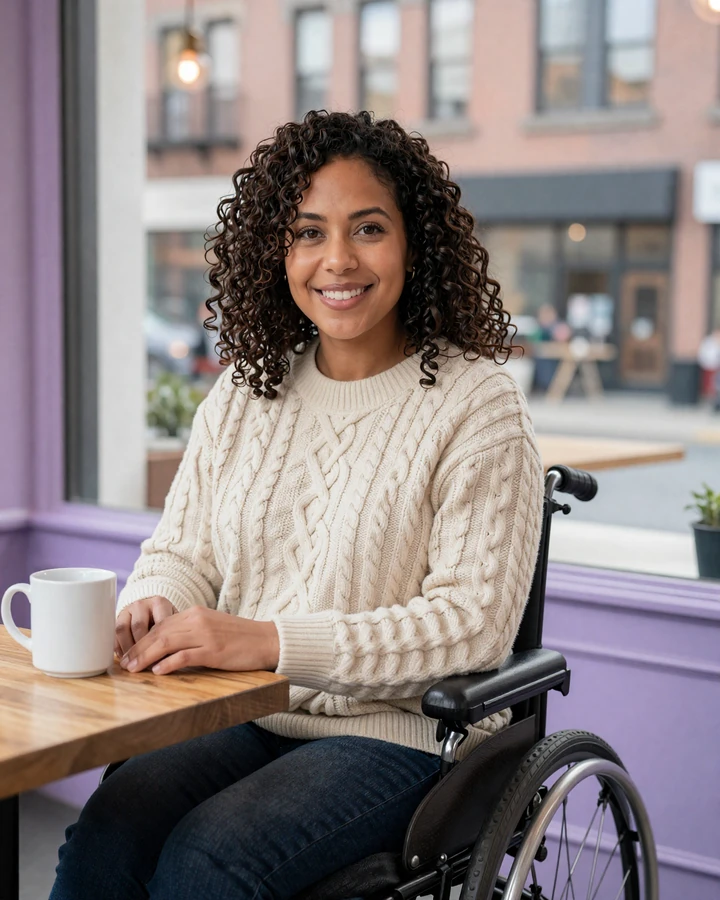
Maya, a woman with cerebral palsy using a power wheelchair, smiling beside a sunny cafe window while browsing a cerebral palsy dating site

Communication and Mobility Realities for Cerebral Palsy Singles

Cerebral palsy is the most common motor disability in childhood, and about 1 in 345 children in the United States is identified with CP (CDC, 2024). Most of those children grow up - into adults who want partnership, intimacy, and the same boring weeknights everyone else gets to have. The honest barriers to that future are rarely the disability itself. They're three predictable patterns on mainstream apps.

Speech variability

Roughly one in four people with cerebral palsy has dysarthria or another speech difference. On a voice-note-first app, that becomes a filter against you before anyone has heard what you actually said. A platform that defaults to text, supports captioned video, and never penalizes longer reply times changes the math entirely.
Mobility and energy

CP affects mobility on a wide spectrum - from independent walking with mild spasticity to full-time power wheelchair use. The shared truth is that every social outing has an energy budget. Mainstream dating apps push toward high-volume "casual" meetups; cerebral palsy singles do better with fewer, well-chosen dates in accessible places.

The pity reflex

Many cerebral palsy adults describe the same exhausting pattern - a match opens with admiration ("you're so inspiring") and quickly slides into either fetishization or sudden ghosting. Neither is partnership. A community where CP is a baseline fact, not a plot twist, short-circuits that reflex before it starts.

What the research actually says

A 2021 review in Developmental Medicine & Child Neurology found that adults with cerebral palsy report the same desire for romantic and sexual relationships as their non-disabled peers, but face significantly more barriers to forming them - primarily social and environmental, not physical. The single largest predictor of relationship satisfaction was a partner who treated CP as one fact among many, not as the defining feature of the relationship.

Filters Built Around How You Actually Move and Communicate

Accessibility filters here are not exclusionary tools - they're shorthand that saves cerebral palsy singles from explaining the same thing on date one, three, and seven. Every field is optional, editable, and visible only to the matches you choose.

Mobility preference

Indicate how you move - independent walking, walker or crutches, manual chair, power chair, or "varies by day." Filter incoming messages by partners who already know what step-free access means.

Communication style

Choose text-first, voice notes welcome, captioned video, AAC-supportive, or "happy to slow the pace." Matches see the preference before they send the first message, so nobody is rushed and nobody is dismissed.

Energy pattern

Mark your typical rhythm - steady, sprint-and-recover, or weather-dependent. Helps you find partners who plan around a real Saturday rather than the Instagram version of one.

Date location radius

Filter to candidates inside a step-free travel radius you choose, including transit accessibility, not just driving distance. Pulls from the same accessibility data layer as our wheelchair-dating community.

See wheelchair dating filters

Identity-first or person-first

You decide whether your profile reads "person with cerebral palsy" or "cerebral palsy adult." Matches see your choice and are encouraged to mirror it in messages. Small detail, large dignity difference.

Verified-only inbox

Toggle a verified-only inbox in one tap. Every account passes a three-second selfie-video check before sending a first message, which blocks recycled photos and most fetishization accounts up front.

Accessible Date Ideas for Cerebral Palsy Couples

Here's the thing: the perfect-on-paper venue means nothing if the accessible entrance is around the back next to the dumpsters. The four principles for choosing a cerebral palsy date location are simple - and they work across cities.

  1. Call ahead. Never trust the website alone. A quick call confirms step-free entry, accessible restrooms, and whether the "accessible table" is actually the one by the bathroom door.
  2. Use AccessNow or the wheelchair-accessible filter in Google Maps. Community-sourced reviews catch what venues quietly omit.
  3. Have a backup. One within a five-minute roll or walk. Plans change; energy budgets shift.
  4. Arrive first if you can. Scouting the space removes the social pressure of solving accessibility in front of a stranger.
City Venue Why it works Energy level
New York Bryant Park lawn & reading room Step-free entry, paved paths, free movable chairs, quiet hours posted, accessible restrooms on-site. Low
London Tate Modern, Bankside Step-free across all floors, large lifts, captioned films, quiet rooms on Level 5. Calls answered for advance access planning. Low-medium
Toronto Harbourfront Centre Boardwalk fully accessible, paved viewing decks, accessible parking close to the water, gentle wind shelter. Low
Melbourne Royal Botanic Gardens - Ian Potter Lake Flat, sealed paths, multiple shaded rest stops, accessible bathrooms at three points, no entry fee. Low
San Francisco SFMOMA + accessible cafe All floors lift-served, generous turn space, captioned audio guides, quiet morning admission slots. Medium

More ideas - fifteen accessible date formats and city-specific notes - in our full wheelchair accessible date ideas guide.

Partner-equality framing

Partners, Not Caregivers

The single most common way a promising cerebral palsy relationship quietly fails has nothing to do with mobility. It's the slow drift from partner to caregiver - usually with everyone's best intentions.

"Even well-meaning non-disabled partners can unconsciously adopt a caregiver frame instead of equal partnership - and that frame, over time, erodes the romantic quality of the relationship. The couples who thrive are the ones who notice the drift early and actively push back against it." - Dr. Sarah Hunt, disability and relationships researcher, United Kingdom

The drift is hard to see while it's happening. It looks like helpful - opening every door, ordering for both of you, deciding the plans because you "know the accessible places." Each individual gesture is fine; the cumulative pattern teaches the relationship that one person decides and the other is decided for. Romance does not survive that arithmetic for long.

Couples who avoid the caregiver pattern tend to share four habits:

  • Reciprocal care is named out loud. The partner with CP gives care too - emotional, logistical, financial, creative - and both partners can list what that looks like.
  • Practical help has a script. "Want help?" not "Let me get that." The question keeps consent and agency in the room.
  • Date nights stay date nights. Medical appointments, equipment errands, and disability admin happen on their own time, not folded into Friday dinner.
  • External support fills external gaps. Personal care assistants, accessible transport, and community resources keep the romantic relationship from absorbing the role of a paid care system.

For a deeper look at how interabled couples build this kind of equality, our community has more in the interabled relationships article - including Dr. Hunt's research in full context.

Leslie and Howard: Cerebral Palsy Love at 55

A common myth says disability dating happens to people in their twenties or not at all. The members of this community are 25, 38, 47, 62. One of the most-shared stories on the platform belongs to a woman who started over at 55 - and met her partner eight years later.

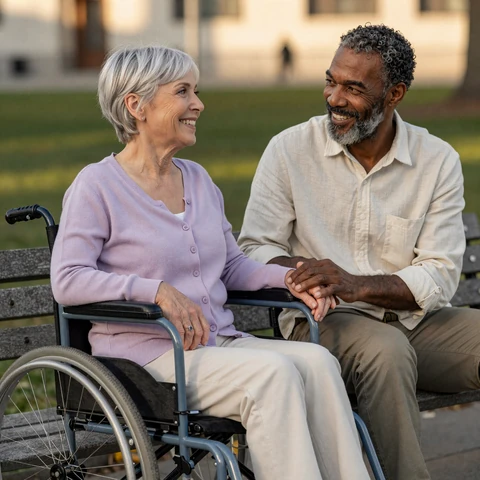
Leslie, a woman with cerebral palsy in a manual wheelchair, holding hands with Howard, her partner with Parkinson’s disease, on a San Francisco park bench

Leslie & Howard

Cerebral palsy & Parkinson’s · Interabled match
Howard drives because I can’t sit comfortably for long. I have a steady hand, so I help him eat. We complement each other - that’s the word he used on our second date, and it’s still the right word three years later.

Leslie became permanently disabled at 55 after a cycling accident; her cerebral-palsy-adjacent diagnosis includes what she calls a "sitting disability" - long stretches in a car or restaurant chair are painful. Eight years later, she met Howard on a disability-specific platform. Howard has Parkinson's disease. His tremor makes some fine motor tasks hard; her steady hand makes them easy. Her sitting limit makes long drives hard; his comfort behind the wheel solves it. Their abilities complement each other - and importantly, neither of them is the caregiver. They share a household, split the planning, and treat their disabilities as facts, not as the relationship's job description.

Read more cerebral palsy and interabled success stories.

Cerebral palsy singles often move between the wheelchair-dating community, the accessible-date-ideas guide, and the interabled relationships hub depending on what they need that week.

Wheelchair Dating Site

The largest community on this platform - accessibility filters, verified profiles, and a venue database built on real wheelchair experience.

Visit wheelchair dating

Accessible Date Ideas

Fifteen low-energy, step-free date formats with city-specific venue notes for New York, London, Toronto, Melbourne, and San Francisco.

Read the guide

Interabled Relationships

How couples where one partner has a disability and the other does not build equal partnership - including Dr. Sarah Hunt’s research on the caregiver trap.

Read the article

Cerebral Palsy Singles: Common Questions

How to find a partner when disabled?

Choose a platform where disability is a baseline fact on every profile rather than a late-game disclosure. Lead with your real interests, use accessibility-aware filters to narrow the inbox to compatible candidates, and look for communities that explicitly name cerebral palsy in their values. Research in Developmental Medicine & Child Neurology (2021) found the strongest predictor of relationship satisfaction for adults with CP was a partner who treated CP as one fact among many - not as the defining feature.

Is there a dating site specifically for cerebral palsy singles?

Yes. DisabledDating includes a dedicated cerebral palsy community with person-first or identity-first profile language, accessibility filters for mobility, communication style, and energy pattern, and moderation trained on cerebral-palsy-specific harms like the "you’re so inspiring" reflex and fetishization. Basic membership is free with no credit card required at signup.

How do I talk about my cerebral palsy on a dating profile?

Three patterns work for most members. A short profile badge that names CP in two words ("Cerebral palsy, power chair user"). A mid-bio mention woven into a hobby ("I bake on the days my hands cooperate, which is most of them"). Or a private disclosure during early chat once the conversation feels right. All three are valid - the platform supports each, and our disclosure guide includes scripts.

What if my speech is hard for new people to understand?

About one in four adults with cerebral palsy has a speech difference. The platform defaults to text messaging, supports captioned video calls, and does not measure "response time" the way mainstream apps do. Members can indicate "captioned video preferred" or "AAC-supportive" on their profile, so matches arrive already comfortable with how you communicate. No script, no apology required.

How do you stop fetishization on a cerebral palsy dating site?

Every account clears a selfie-video verification before sending a first message, which blocks recycled photos and most devotee-style accounts at the door. Moderators are trained on cerebral-palsy-specific red flags, including unsolicited messages focused on assistive devices, spasticity, or speech patterns. Confirmed fetishization accounts receive permanent device-level bans, and members can filter to verified-only inboxes in one tap.

Can interabled couples - one partner with CP, one without - actually work?

Yes, and the data is clear about what makes them work. The healthiest interabled couples avoid the caregiver drift Dr. Sarah Hunt describes by naming reciprocal care out loud, scripting practical help ("Want help?" rather than "Let me"), and keeping medical admin separate from date nights. Leslie and Howard, profiled above, are a working example: their abilities complement each other, and neither plays the caregiver role.

What does an accessible first date actually look like?

A low-energy, step-free venue with a confirmed accessible restroom, called ahead the same week. Bryant Park in New York, the Tate Modern in London, Harbourfront Centre in Toronto, the Royal Botanic Gardens in Melbourne - all proven by community members. The principle: a venue you’ve already verified, a backup within five minutes, and an exit plan if energy drops. Our accessible date ideas guide has fifteen formats.

Is the cerebral palsy dating site free?

Yes. The basic tier is free with no credit card required at signup. Profile creation, browsing, messaging, accessibility filters, captioned video calling, and selfie-video verification are all included. Premium adds advanced filters like step-free travel radius, read receipts, and private photo galleries - but every core cerebral palsy dating feature stays free for everyone in the community.

Find cerebral palsy love on a site that already gets it

Create a free, verified profile in under ten minutes. Accessibility filters, person-first or identity-first language, equal-partnership community.

Free to join · No credit card · Verified profiles · WCAG 2.2 compliant