

ADHD & AuDHD singles · Verified profiles

ADHD Dating Site

ADHD Dating Site for Real ADHD Relationships

Meet neurodivergent singles who already know that "I forgot to text back" is not the same as "I lost interest." Verified profiles. AuDHD-friendly filters. No three-day reply rules, no shame about a hyperfocus deep-dive at 2am.

See How It Works

Free to browse · No credit card · Selfie-video verified · Neurodivergent-affirming

Nora, a redhead woman with ADHD smiling at her phone in a cozy home office while using an ADHD dating site

How ADHD Shapes Dating: Time Blindness, Impulsivity, Hyperfocus

Dating with ADHD is a neurodivergent experience, not a character flaw. The Centers for Disease Control and Prevention estimate 6.0% of US adults - roughly 15.5 million people - currently have an ADHD diagnosis (CDC, 2023). Three traits show up in almost every adult ADHD relationship, and naming them out loud is the first step to a partnership that actually works.

Time blindness

Ten minutes and ninety minutes feel identical from the inside. It's not disrespect - it's a difference in interoceptive time perception. Partners who learn to interpret "I'll be ready in five" as "give me a fifteen-minute buffer" build trust faster than partners who keep score.

Impulsivity

The good version is a same-day road trip to a state park. The hard version is a 1am cart of bedroom furniture you don't have space for. ADHD impulsivity is a feature with edges, and the strongest ADHD couples build small "pause rituals" - twenty-four hours on any purchase over $200, for instance - before the dopamine peaks.

Hyperfocus

When an ADHD brain locks onto something - a person, a project, a video essay - the rest of the world fades. Early in dating, this looks like an obsessive new-crush intensity. Later, it can mean a partner accidentally skips dinner. Hyperfocus isn't a moral failing; it's a regulation gap you can plan around.

One more trait worth naming: rejection sensitive dysphoria

An estimated 70% of adults with ADHD report rejection sensitive dysphoria (RSD) - the experience of intense emotional pain in response to perceived rejection or criticism (William Dodson, MD, ADHD specialist). On a dating app, an unanswered message can feel like a verdict on your whole self. Knowing the name takes most of its power away. On this platform, slow replies are normal - most members understand the difference between silence and a no.

ADHD love superpowers

The ADHD Love Superpowers Your Partner Will Notice

The conversation about ADHD relationships skews toward what's hard. The reality is that ADHD brains bring real, repeatable strengths to a partnership - and the people who date neurodivergent partners on purpose tend to list these out first.

  • Romantic enthusiasm. The same hyperfocus that sinks an evening into a documentary also pours full attention into a new partner. Early-relationship energy is genuine, not performative.
  • Creative problem-solving. ADHD pattern-recognition often connects unrelated dots faster than neurotypical linear thinking. Date-night logistics, gift ideas, surprise adventures - all benefit.
  • Empathy and emotional honesty. Years of being told you're "too much" tends to produce adults who don't hide what they feel. Healthy ADHD relationships run on direct, unmasked emotional communication.
  • Spontaneity that actually happens. The Tuesday-night sunset drive. The "let's just try this new place." The willingness to be surprised by your own life.
  • Loyalty in the boring stretches. Once an ADHD partner builds a routine around someone they love, that person becomes a stable anchor - not an item on a checklist.
"Dating someone with ADHD means accepting that your partner's attention is one of the most generous things they own. When they give it to you, they're giving you a resource they have to fight for every day." - Dr. Edward Hallowell, author of ADHD 2.0

What members tell us they're looking for

  • A partner who doesn't take an unanswered text personally
  • Someone who treats body-doubling as romance, not weirdness
  • Patience with the laundry-pile cycle
  • Curiosity about hyperfocus topics instead of eye-rolls
  • Direct communication - no guess-the-mood games
AuDHD dating

AuDHD Dating: When ADHD and Autism Overlap

AuDHD describes adults who are both Autistic and ADHD - a co-occurrence that research suggests is far more common than the diagnostic system originally allowed. A 2022 meta-analysis in the Journal of Attention Disorders found that 50-70% of Autistic adults also meet criteria for ADHD, and the experience of dating with both is meaningfully different from either alone.

AuDHD members often describe a kind of internal traffic jam: the ADHD half wants novelty, spontaneity, and a new conversation; the Autistic half wants routine, depth, and predictable scripts. The result is a brain that can hyperfocus on a partner for six hours and then need three full days of sensory recovery - without that being a contradiction.

On a typical dating app, this pattern reads as "hot and cold." On a neurodivergent dating site, it reads as a recognizable rhythm. Our profiles include AuDHD-specific fields:

  • Energy pattern preference - sprint-and-recover, steady, or seasonal
  • Communication style - text-first, voice-note, video, in-person
  • Sensory profile - sound-sensitive, light-sensitive, texture-sensitive, scent-sensitive
  • Masking preference - unmasked, partially masked at work, never disclose to family
  • Stimming visibility - your stims are welcome in photos, on video calls, and on first dates

These fields aren't filters for exclusion - they're shorthand so two AuDHD adults don't spend three dates decoding each other. Members who want to read more about the overlap can move on to our neurodivergent dating guide or the autism dating community, which uses identity-first language across the platform.

Communication Tools That Work for ADHD Marriage

An ADHD marriage isn't a watered-down version of a neurotypical one - it's a different operating system, and the couples who thrive build their own toolkit. These five practices come up again and again in member success stories and in the clinical work of Melissa Orlov, author of The ADHD Effect on Marriage.

  1. Externalize the calendar

    If it's not in a shared digital calendar with an alert, it doesn't exist for the ADHD partner. This isn't laziness - it's working memory architecture. Couples who use one shared calendar (and stop relying on "I'll remember") report dramatically fewer missed anniversaries, appointments, and bills.

  2. Body-doubling for hard tasks

    Body-doubling is the practice of simply being in the same room - or on the same video call - while one partner does a task they've been avoiding. For ADHD adults, the presence of another regulated nervous system can unlock paperwork, dishes, or a tough phone call. It is, unironically, romantic.

  3. The 24-hour impulse rule

    For any decision over a pre-agreed threshold - a major purchase, a job change, an apartment move - both partners agree to wait 24 hours. The ADHD partner gets the dopamine peak out of their system; the non-ADHD partner gets a real conversation. The threshold itself is negotiated, not imposed.

  4. Naming RSD when it arrives

    When the ADHD partner spirals after a tiny criticism, the magic phrase is "I think I'm having an RSD wave." It's not a free pass - it's an off-ramp. The other partner learns to wait twenty minutes before continuing the conversation. The wave passes; the relationship doesn't.

  5. Repair rituals, not perfect days

    ADHD couples don't avoid conflict - they shorten its half-life. A repair ritual (a specific phrase, a walk together, a shared snack) signals "we are back to us." The goal isn't never to misfire. The goal is to return faster every time.

  6. Medication conversations are partnership conversations

    Whether the ADHD partner takes medication, has tried it, or chooses not to, that decision affects daily life together. The healthiest couples treat it as shared territory - not a "fix" the non-ADHD partner imposes, and not a private medical secret. Either is workable; silence isn't.

Why an ADHD-Specific Dating Site Outperforms Mainstream Apps

ADHD adults face specific harms on swipe-driven platforms - the high-novelty design rewards exactly the behaviors that make ADHD dating harder. A dedicated community changes the incentives.

6.0%
of US adults currently have an ADHD diagnosis (≈15.5M people)
CDC, 2023
50-70%
of Autistic adults also meet criteria for ADHD (AuDHD)
Journal of Attention Disorders, 2022
70%
of ADHD adults report rejection sensitive dysphoria
Dr. William Dodson, ADHD specialist
4 hrs
median moderation response on this platform
Internal trust & safety, Q1 2026

ADHD Love Stories From Our Members

ADHD love is not a punchline or a warning label. It's a real category of grown-up relationship - sometimes neurodivergent on both sides, sometimes mixed. Two member stories, shared with permission.

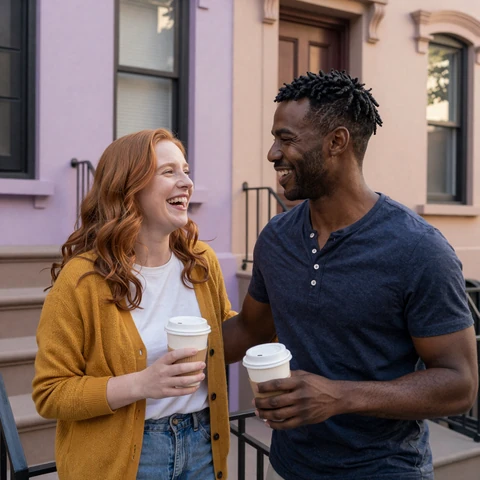
Nora and Jamal, an ADHD couple, laughing together with coffee cups on a Brooklyn brownstone stoop at golden hour

Nora & Jamal

ADHD + ADHD · Together 2 years
Our first date was supposed to be coffee and turned into nine hours and three neighborhoods. Neither of us apologized for losing track of time, because the other one had too. That was the moment I knew.
Talia and Reuben, an AuDHD and neurotypical couple, holding hands at the Portland Saturday market in soft daylight

Talia & Reuben

AuDHD + neurotypical · Married 2026
Reuben learned my rhythm before he met me - he read my profile carefully. By date three he was buffering an extra fifteen minutes into every plan without making a thing of it. Three years later that's our marriage.

Read more ADHD dating success stories.

ADHD rarely shows up alone. Many members cross between the autism dating community, the neurodivergent dating guide, and the ADHD relationships hub depending on the conversation they need that week.

Autism Dating Site

Identity-first community for Autistic adults - detailed profiles, low-pressure messaging, sensory filters. The natural overlap for AuDHD singles.

Visit autism dating

Neurodivergent Dating Guide

A full guide to neurodiverse couples, first-date scripts, unmasking, and communication tools - written by and for neurodivergent adults.

Read the guide

ADHD Relationships Guide

Deeper dive into time blindness, RSD, hyperfocus, and ADHD marriage. Communication strategies you can use tonight.

Read the article

Dating Someone With ADHD: Common Questions

How to find a partner when disabled or neurodivergent?

Choose a platform where neurodivergence is a profile-level fact rather than a late-game disclosure. Lead with your real interests and humor, use verification filters to limit your inbox to real accounts, and look for communities that explicitly name ADHD, autism, and AuDHD in their values. Research in Disability Studies Quarterly found 34% higher relationship satisfaction when neurodivergent disclosure happens early and on the disabled person's own terms.

Is dating someone with ADHD hard?

It's different, not harder. The strongest ADHD relationships use externalized calendars, body-doubling for hard tasks, repair rituals after conflict, and a shared vocabulary for rejection sensitive dysphoria. Partners who learn the rhythm - short bursts of high engagement followed by recovery, time blindness around plans, hyperfocus deep-dives - build relationships that often outlast neurotypical-only pairings.

What is AuDHD and how is it different from ADHD?

AuDHD describes adults who are both Autistic and ADHD. A 2022 meta-analysis in the Journal of Attention Disorders found 50-70% of Autistic adults also meet ADHD criteria. AuDHD daters often experience an internal pull between novelty-seeking and routine-seeking, which can read as "hot and cold" on mainstream apps but registers as a normal rhythm on a neurodivergent dating site with energy-pattern and sensory profile fields.

What is rejection sensitive dysphoria and why does it matter for ADHD dating?

Rejection sensitive dysphoria (RSD) is the intense emotional pain ADHD adults often feel in response to perceived rejection or criticism. Roughly 70% of ADHD adults report it (Dr. William Dodson). In dating, an unanswered message can land as a verdict on the whole self. Naming RSD out loud to a partner gives both people an off-ramp - a twenty-minute pause that lets the wave pass before the conversation continues.

Can ADHD marriage actually work long-term?

Yes - and the research is increasingly clear about how. Couples therapist Melissa Orlov's clinical work with hundreds of ADHD marriages identifies the same predictors: a shared external system for memory and time, body-doubling on hard tasks, a 24-hour rule for big impulse decisions, treatment decisions made together rather than imposed, and short repair rituals after conflict. The couples who use these tools report higher satisfaction than the general population, not lower.

How does this ADHD dating site protect against ableist matches?

Every account clears a three-second selfie-video verification before sending a first message, which blocks recycled photos and AI-generated profiles. Our moderation team is trained on neurodivergent-specific harms - including the "high-functioning" condescension pattern and the "you don't look ADHD" dismissal. Members can filter to verified-only inboxes and to other neurodivergent users. Confirmed ableist accounts receive permanent device bans.

Do I have to disclose my ADHD on my profile?

No, but most members find that early disclosure improves match quality. Three strategies work: a quiet badge on your profile so matches see it before messaging, a casual mid-bio mention ("late-diagnosed ADHD, hyperfocus on bread-baking right now"), or a private disclosure during early chat. The platform supports all three. Our disclosure guide includes scripted opening lines for each approach.

Is the ADHD dating site free?

Yes, the basic tier is free with no credit card required at signup. Profile creation, browsing, messaging, AuDHD profile fields, and selfie-video verification are all included. Premium adds advanced filters like AuDHD-specific cross-matching, read receipts, and private photo galleries - but the core ADHD dating features stay free for everyone.

Find your ADHD match on a site that gets your brain

Create a free, verified profile in under ten minutes. AuDHD-friendly filters, neurodivergent-affirming community, no three-day reply rules.

Free to join · No credit card · Verified profiles · Neurodivergent-affirming