
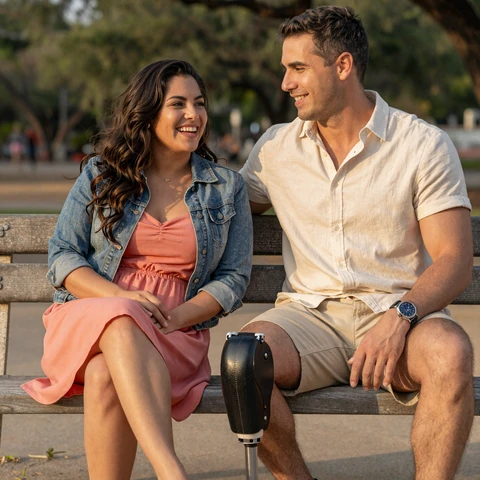
Damaris & Theo
BKA · Together 18 monthsTheo never asked the questions I was bracing for. He asked what music I run to. Three dates in, my prosthetic was just my leg and not a topic.
Meet AKA, BKA, AE, BE, and bilateral amputee singles, plus partners who already know that "stump," "socket," and "running blade" are just words - not punchlines. Verified accounts. Anti-devotee moderation. Zero patronizing questions about how you put on your jeans.
Free to browse · No credit card · Selfie-video verified · Anti-fetish policy
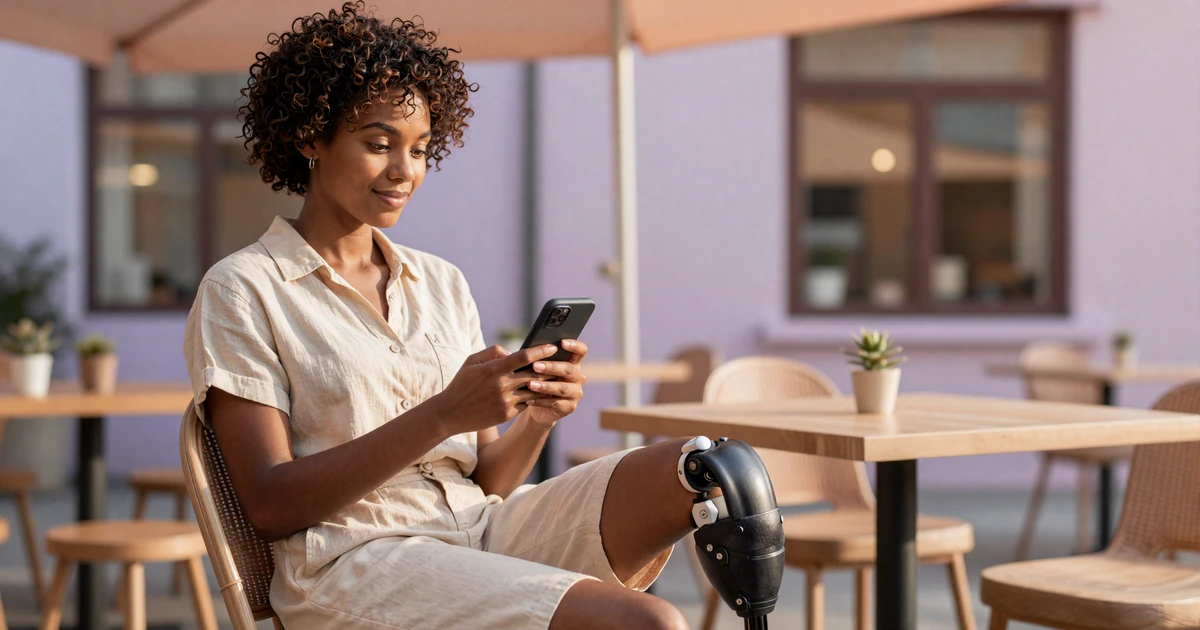
An amputee dating site should be the easiest place online to be seen as a whole person - and for most of the web it's the opposite. Search "amputee dating" and the first wave of results is built for devotees, not for the singles themselves. We built DisabledDating to fix that.
Amputation is one of the protected disabilities under the Americans with Disabilities Act of 1990, alongside conditions like cerebral palsy, blindness, epilepsy, and PTSD. That legal recognition matters because it shapes the language, the workplace, and the dating pool. Roughly 2.1 million people in the United States live with limb loss, and that number is projected to double by 2050 - yet mainstream dating apps still treat a prosthetic photo as a conversation killer instead of a complete sentence.
Our membership skews 28-55, mixes congenital limb difference with traumatic, surgical, and vascular amputation, and includes veterans, athletes, parents, freelancers, and night-shift nurses. What ties the community together is simple: people who already understand phantom pain, socket fit, weather flare-ups, and the boring math of an airport security line.
You get to lead with whatever you want - your music taste, your job, your dog, your sense of humor. Your residual limb is a fact, not a headline. And if a partner ever needs to learn the words for what they're looking at, that's a fifth-date conversation, not a first-message interrogation.
Person-first or identity-first language is your choice - toggle it in your profile preferences and we honor it across the platform.
Amputee dating profiles use a small set of shorthand terms to describe level and side. Knowing them upfront means you can read a bio without asking - and write your own without over-explaining. Here are the abbreviations members use most.
| Term | Meaning | Common in profiles as |
|---|---|---|
| AKA | Above-Knee Amputation - limb removed above the knee joint | "Right AKA, ten years out, blade for runs" |
| BKA | Below-Knee Amputation - limb removed below the knee, knee preserved | "Left BKA, congenital, full-time prosthetic user" |
| AE | Above-Elbow - upper-limb amputation above the elbow joint | "AE on the dominant side, myoelectric arm" |
| BE | Below-Elbow - upper-limb amputation below the elbow | "BE since age 4, body-powered hook for work" |
| Bilateral | Both limbs on the same level affected (legs or arms) | "Bilateral BKA, military service, road cyclist" |
| Through-knee / Symes | Disarticulation at the knee or ankle joint | "Through-knee, prefer hiking dates" |
| Congenital / Acquired | Born with limb difference vs. amputation later in life | "Congenital BE, no prosthetic, ASL-friendly" |
| Residual limb | The remaining portion of the limb after amputation (preferred over "stump" in profiles) | "Residual limb is sensitive in winter, plan accordingly" |
If a profile says "bilateral BKA, athletic prosthetics, traumatic" - that's both legs amputated below the knee, sport-grade limbs for activity, and the cause was an injury rather than birth or surgery. Three abbreviations, full picture.
Devoteeism is the fetishization of disability in a romantic or sexual context - when a partner pursues someone because of the amputation rather than the whole person. It's the photographic flip side of desexualization, and it's the single most common harm reported by amputee singles on mainstream apps.
The pattern is recognizable: messages that fixate on stump length, requests for "without the prosthetic" photos before a name has been exchanged, oddly specific questions about how you bathe or sleep. A partner who can't talk about your job, your weekend, or your favorite restaurant - only about your body - is not pursuing dating an amputee. They're pursuing a category.
Here's the thing: not every curiosity is a red flag. A new partner asking respectful questions in week three is normal. The pattern only becomes harmful when curiosity replaces personhood. Our moderation team is trained to spot that difference.
Every account on this amputee dating site clears a three-second selfie-video check before sending a first message. The system blocks recycled photos, AI-generated faces, and the recycled "devotee" burner accounts that pass through stock-photo profiles on mainstream apps. Verification takes under a minute and the video is never published - only the green check on your profile.
Turn your head slowly left and right. No prompts about your body, no requests to remove a prosthetic, no medical questions. Just a face.
The clip is matched against your profile photos and screened for AI artifacts. Edge cases - including members who cover their face for cultural reasons - go to a human reviewer.
Once verified, the original clip is deleted within seven days. Only the verified status persists. Members can filter to message verified profiles only.
There's no rule about whether your residual limb or prosthetic should appear in your profile photos. Some members lead with it, some never show it, and both approaches work. What matters is consistency: matches should know what to expect before they meet you. Three photo strategies our most-matched members use.
Four to six photos from your normal week - coffee, hiking, kitchen, friend's wedding. Your prosthetic appears in two or three of them, no special framing, no zoom. The message is: "this is my body in my life." Most amputee singles report the highest match quality with this approach because the filtering happens before the first message rather than after.
Open with what you love doing - paddleboarding, climbing, a salsa class, holding your niece. If your sport limb or running blade is part of the activity, it shows naturally. Members with congenital limb difference often prefer this approach because it sidesteps the "what happened to you?" question entirely.
"I stopped hiding my prosthetic in profile photos three years ago and my match quality jumped overnight. The people who would have left at month two now never message in the first place. That's a feature, not a loss." - Damaris, BKA, joined 2023
Your main grid shows your face, your hobbies, and your day-to-day. A second private gallery - unlocked only after you mutually opt in - holds clearer photos of your residual limb, prosthetic, or scars. This works well for members in early stages of post-traumatic amputation or for anyone who wants to control the disclosure pace themselves.
Close-up shots of the residual limb alone, no face visible, no other context - these images get scraped onto devotee sites and pull a different inbox than you want. If you want to show your residual limb, keep your face and your full self in the frame. The platform's image-hash watermark also flags any photo that appears off-site without permission.
The harm gap between mainstream dating apps and disability-inclusive platforms is real, measurable, and the reason members keep choosing dedicated communities.
Amputee love isn't a niche storyline - it's the everyday outcome on this platform. Two of our most-shared stories, both shared with permission.
Theo never asked the questions I was bracing for. He asked what music I run to. Three dates in, my prosthetic was just my leg and not a topic.
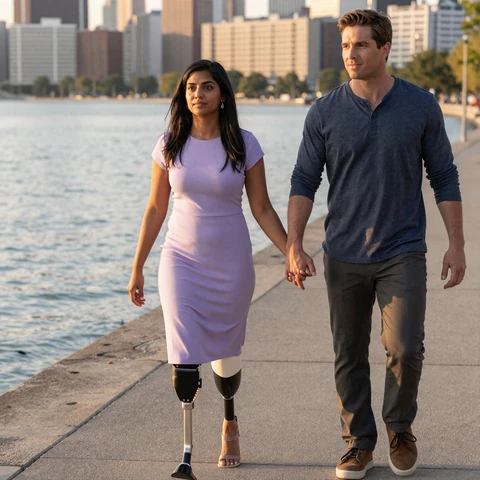
I told Marc on date one that the second hour would be slower because of my sockets. He picked the next four venues himself with that in mind. That was the moment.
Amputee singles often connect across overlapping communities - especially with wheelchair users (many bilateral amputees use chairs full or part time) and with members navigating their first disclosure conversations.
For manual, power, paraplegic, and quadriplegic singles. Accessibility filters, anti-fetish moderation, and venue tags overlap fully with the amputee community.
Meet wheelchair singlesMobility, speech, and energy-budget preferences are first-class profile fields - a natural cross-over community for many amputees with secondary mobility needs.
CP singles communityA three-stage disclosure model with scripts for amputees: profile photo, early chat, deeper conversation. Includes data on satisfaction outcomes.
Read the disclosure guideYes - DisabledDating welcomes singles with and without disabilities, including men seeking women with limb loss or other disabilities. The platform pushes back hard on devoteeism, so the matches you find are people who want a relationship with a whole person, not a category. Verified profiles, anti-fetish moderation, and a clear anti-ableism policy keep the dating pool authentic.
Three things consistently raise outcomes: choose a disability-inclusive platform where disclosure happens at the profile level, lead with your interests and humor before your medical history, and use verification filters to limit your inbox to confirmed real accounts. Disability Studies Quarterly research found 34% higher relationship satisfaction when disclosure happens early and on the disabled person's own terms.
AKA stands for Above-Knee Amputation, BKA for Below-Knee Amputation, AE for Above-Elbow, and BE for Below-Elbow. "Bilateral" means both limbs at the same level. So "bilateral BKA" describes both legs amputated below the knee. Members use these shorthand terms so a profile reads cleanly without medical over-explanation.
Many that rank highly on search are, which is why DisabledDating exists. Our anti-devotee policy is public, our moderation team is trained on devotee language patterns, and we permanently device-ban confirmed devotee accounts. We also refuse traffic and ad partnerships from devotee directories. Quarterly trust and safety reports share the removal numbers openly.
No. Members choose how visible their amputation is. Three strategies work: the natural-life set where your prosthetic appears in two or three of your everyday photos, the activity lead where your sport limb shows in motion, and the private gallery where deeper photos unlock only after mutual opt-in. There's no right answer - only what matches the pace you want.
You record a three-second clip turning your head slowly left and right. The clip is matched to your profile photos and screened for AI artifacts and recycled images. The video is deleted within seven days - only the green verified check stays on your profile. Members can filter to message verified accounts only, which drops catfishing rates to near zero.
The relationship itself isn't fundamentally different - communication, trust, and shared interests still do most of the work. The practical differences are logistical: planning venues with accessible parking and seating, understanding socket-fit weather flare-ups, respecting energy budgets after a long-walking day. Partners who learn those rhythms early build relationships that last.
Yes, the basic tier is free with no credit card required at signup. Profile creation, browsing, messaging, and selfie-video verification are all included. Premium adds advanced filters, read receipts, and the private photo gallery, but core amputee dating features stay free for everyone.